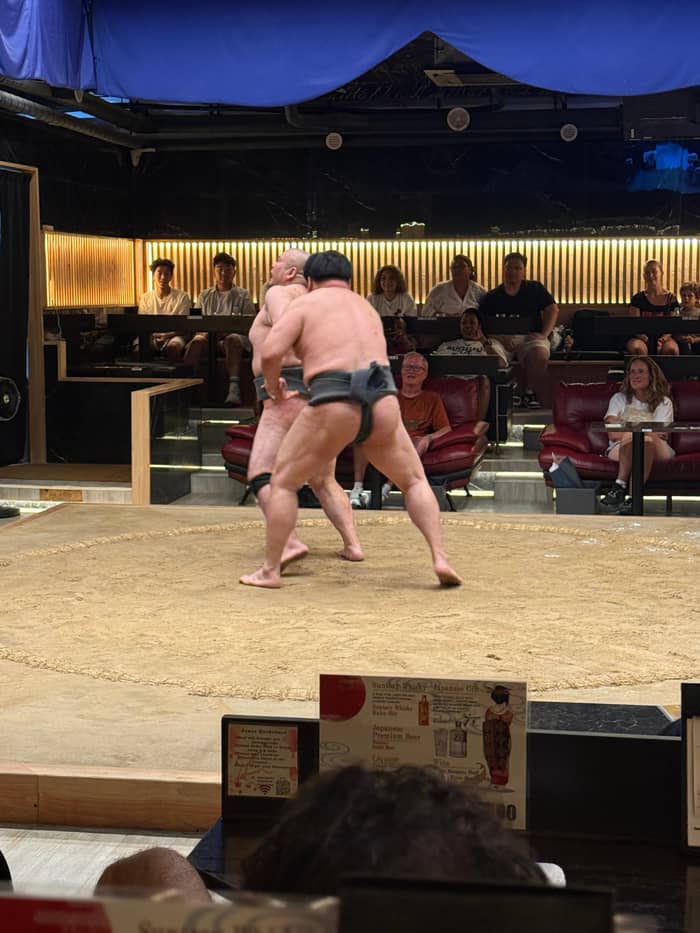
Regular meal
Standard seat
The widest view of the room
See this showInteractive to-do list
Live sumo show with kaiseki dinner
★ 4.9 · 257 ratings
Quick summary
The sumo dinner in Tokyo at the Ginza show is a kaiseki meal that comes with the ticket, and at the 17:00 show the Standard and Premium seats get a chanko nabe and a tempura rice box.
At the table
Your list · 6 items
Tick off each point as you complete it. This device keeps your progress.
0 / 6 ready
That is everything. Only the booking is left: your night and your seat at the ring.
Reserve a spotWhat is served at the Ginza sumo dinner, who gets which dishes, which swaps cost extra, and how halal, vegan, children's and allergy requests are handled.
Editorial team, ginzasumoshows.com · Updated November 6, 2026 · Read in 7 min
The essentials
The ticket for the Ginza show is not a seat with a snack attached. It buys a kaiseki meal and a view of the show, and the venue states that the ticket price covers both.1 The operator also says the dining is designed as an integral part of the show, planned between 5:00 PM and 6:00 PM.9 That timing shapes the whole evening, because the food belongs to the program instead of being something you finish before it starts.
Kaiseki is the formal, multi-course style of Japanese dining, served in small separate dishes rather than one large plate. The venue calls itself a sumo live restaurant and has a glass-walled open kitchen, so the cooking is part of what you watch.10 Guests may keep dining and drinking as the show goes on, which means the room never stops for a meal service.11 The result feels closer to dinner theater than to a sporting fixture.
It helps to set expectations early. The venue says its performance is not an official Grand Sumo match but an experience-style sumo entertainment show.12 Anyone searching for a sumo dinner in Tokyo is therefore buying a show with a meal, and the useful questions are which meal comes with which seat, what costs extra and what can be changed. The sections below take them in that order.
Meal by seat
| Seat | Main dishes | Swaps | Child price |
|---|---|---|---|
| Standard | Chanko nabe and tempura rice box2 | Yes, for a fee4 | Yes21 |
| Premium | Chanko nabe and tempura rice box2 | Yes, for a fee4 | Yes21 |
| VIP ringside | Chanko nabe, tempura, eel and wagyu steak22 | Not offered4 | No21 |
Meals and swaps come from the venue's dining page and FAQ and apply to the 17:00 show only.19
The venue serves a different meal depending on which show your ticket is for. Its dining page lists a kaiseki lunch at the 12:00 show, a kaiseki dinner at the 17:00 show and a light kaiseki of small dishes at the 20:30 show.17 Drinks are ordered separately at the first two, while the late show includes one drink.3 The Viator listing this guide is built around sells a 5:00 PM show, so the evening dinner described below is the one that applies to it.
The late show is the lighter option. On some dates the venue runs it as a second show from 20:30 to 22:30, with the same content and ticket price as the main show but a different meal.18 If you are choosing between the two, think about how hungry you will be: the 17:00 menu is a full sit-down dinner, while the late menu is built from smaller plates.17
Check which meal your ticket carries before you pay. The venue offers its paid meal swaps only for the 17:00 show.19 Changes to the halal set or the vegan kaiseki cost nothing extra at both the 17:00 and the 20:30 show.5 Everything from here on describes the 17:00 dinner, the one most travelers book.
Seat price at the venue
Adult prices in yen on the venue's own list for the 17:00 and 20:30 shows, tax included.20 The Viator listing is a separate product with its own price.
Guests in the Standard and Premium seats receive the regular kaiseki. Its main dishes are a tempura rice box and a chanko nabe, the hot pot long associated with sumo kitchens, and some dishes can be changed for an extra charge.2 The venue lays the meal out as a starter of sesame tofu with goji berries and wasabi, a hassun plate of simmered spinach and chrysanthemum with dried-fruit shira-ae, millet-gluten dengaku and poppy seeds, then the nabe, the rice box and a fruit anmitsu to finish.30
The venue lists the allergens in this meal as shrimp, wheat, egg, milk, orange, soy, chicken, apple and sesame, and asks anyone with an allergy to get in touch beforehand.31 It also explains that its in-house kitchen cannot completely rule out cross-contamination, so it cannot call any dish 100 percent safe for an allergy and suggests bringing your usual medication.28 Take that seriously if your reaction is severe: the honest answer from the venue is to ask first and carry what you normally carry.
On beef, the regular kaiseki at these seats uses none, though it does contain chicken.26,24 That matters if you avoid red meat but eat poultry. Guests who eat no meat at all are pointed to the vegan kaiseki instead.24 And if the idea of raw fish worries you, the venue says it serves no dishes made with it.8
Match your table
Find the diner you are feeding, then read across to the meal that fits.
If I eat no meat at all
The vegan kaiseki
The vegan set is plant-based, while the regular sets contain chicken.24,25
If I avoid beef
A Standard or Premium seat
The regular kaiseki uses no beef, and the VIP steak is removed on request.26
If I keep halal
The halal set, free to change
The change costs nothing extra and has a deadline three days before the show.5,6
If I am bringing a child aged 3 to 12
The castle box
It is a two-tier box with hamburger steak and fried shrimp, with a child price outside VIP.27,21
If I want a steak or an eel
Pay for a swap at Standard or Premium
The venue prices the eel swap at 2,000 yen and the steak swap at 4,000 yen.4
If I have a food allergy
Ask first, carry medication
The venue cannot rule out cross-contamination and asks for requests through its inquiry form.28,29
Three seats
Regular meal
The widest view of the room
See this show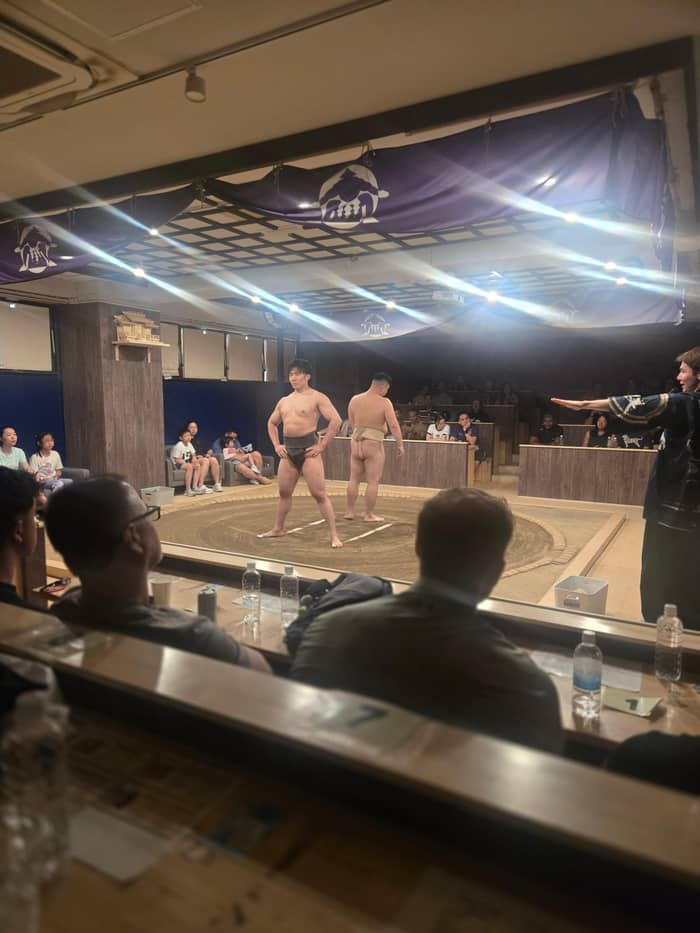
Regular meal
Front seats near the ring
See this show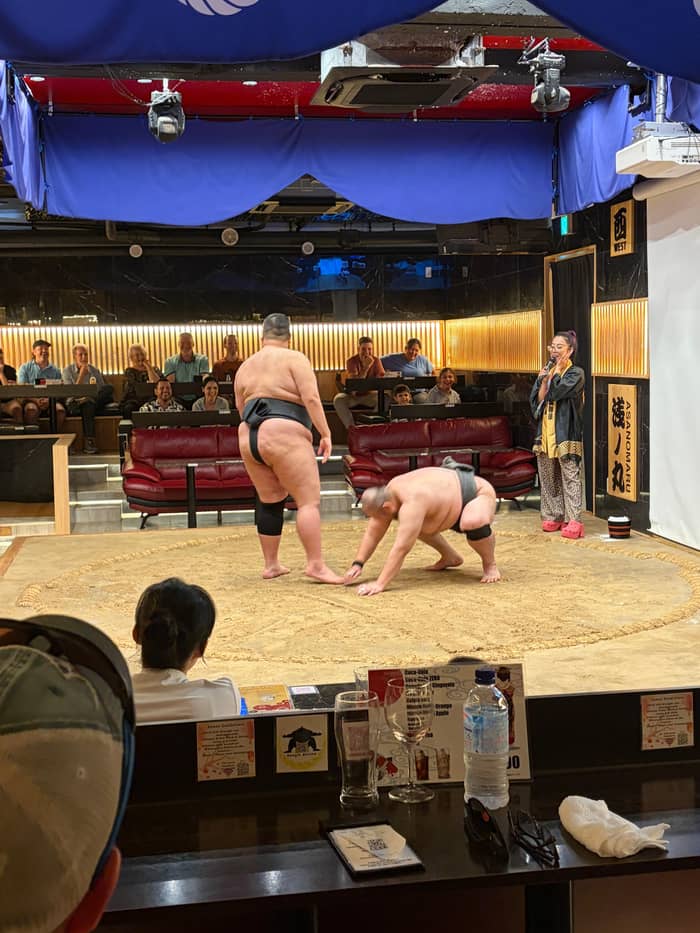
Special kaiseki
Front row, venue tickets only
The special kaiseki is served only at the VIP ringside seats, which the venue describes as a limited run of 9 front-row seats.34 At the 17:00 show it brings the chanko nabe and the tempura together with grilled eel, a 60 g wagyu steak with fresh wasabi, white rice and a fruit anmitsu.22 The Viator listing offers a Standard Seat and a Premium Seat, so the VIP set is not part of that listing. Up front, sumo wrestling and dinner in Tokyo meet at arm's length.
The tier has a price to match. On the venue's own price list, adults pay 27,000 yen at VIP ringside, 21,000 yen at Premium and 17,000 yen at Standard for the 17:00 and 20:30 shows, tax included.20 There is no child price at VIP ringside.21 Those are the venue's direct prices for its own tickets, which are a separate product from the listing priced from $123 on Viator.
For anyone who does not eat beef the venue removes the wagyu steak from the VIP set on request, and it takes the hamburger steak out of a child's plate the same way.26 Ask before the evening rather than at the table: the venue asks that allergy and gluten-free requests go through its inquiry form beforehand.29
Price a sumo dinner
Enter your group size and compare four Tokyo sumo shows that serve food, side by side.
Compare all 4 options
Enter your group size and compare four Tokyo sumo shows that serve food, side by side.
≈
View≈
View≈
View≈
ViewAll amounts are from-prices on GetYourGuide, converted at the ECB reference rate. Exact prices are shown at booking.
The evening, course by course
10 minutes before
The venue's terms ask guests to arrive at least 10 minutes before the show starts.13
5:00 PM
The operator plans the meal for the first hour of the show, between 5:00 PM and 6:00 PM.9
About 45 minutes
The venue's own running order opens with a meal of about 45 minutes before the sumo itself begins.14
During the show
Drinks and dishes can be ordered through a QR code at the seat while the show runs.15
3:00 PM on the day
The Viator listing sets vegan requests by 3:00 PM Japan time on the show day.
After the bouts
The sake bar and shop can be used without a show ticket, before or after the performances.16
Standard and Premium ticket holders can change part of the meal for a fee. The venue lists its swaps as follows: the chanko nabe for a wagyu sukiyaki at 2,000 yen, the tempura rice box for an eel rice box at 2,000 yen, and the tempura rice box for a wagyu steak with white rice at 4,000 yen.4 The eel swap is the cheaper way to upgrade, and the steak swap is the most expensive on the list.
The swaps are sold only for the 17:00 show, and you arrange them after buying the ticket, on a separate food-option page the venue sets up for ticket holders.19,35 The Viator listing says its kaiseki can be changed for an additional fee, but the record carries no amounts, so treat the yen figures above as the venue's own price list.
Deadlines matter as much as prices. The Viator listing asks for halal requests by 11:00 PM Japan time three days before the show date and vegan requests by 3:00 PM Japan time on the day of the show. The venue's own FAQ gives the same logic in 24-hour form: 23:00 three days ahead for halal and 15:00 on the day for vegan.6
Video
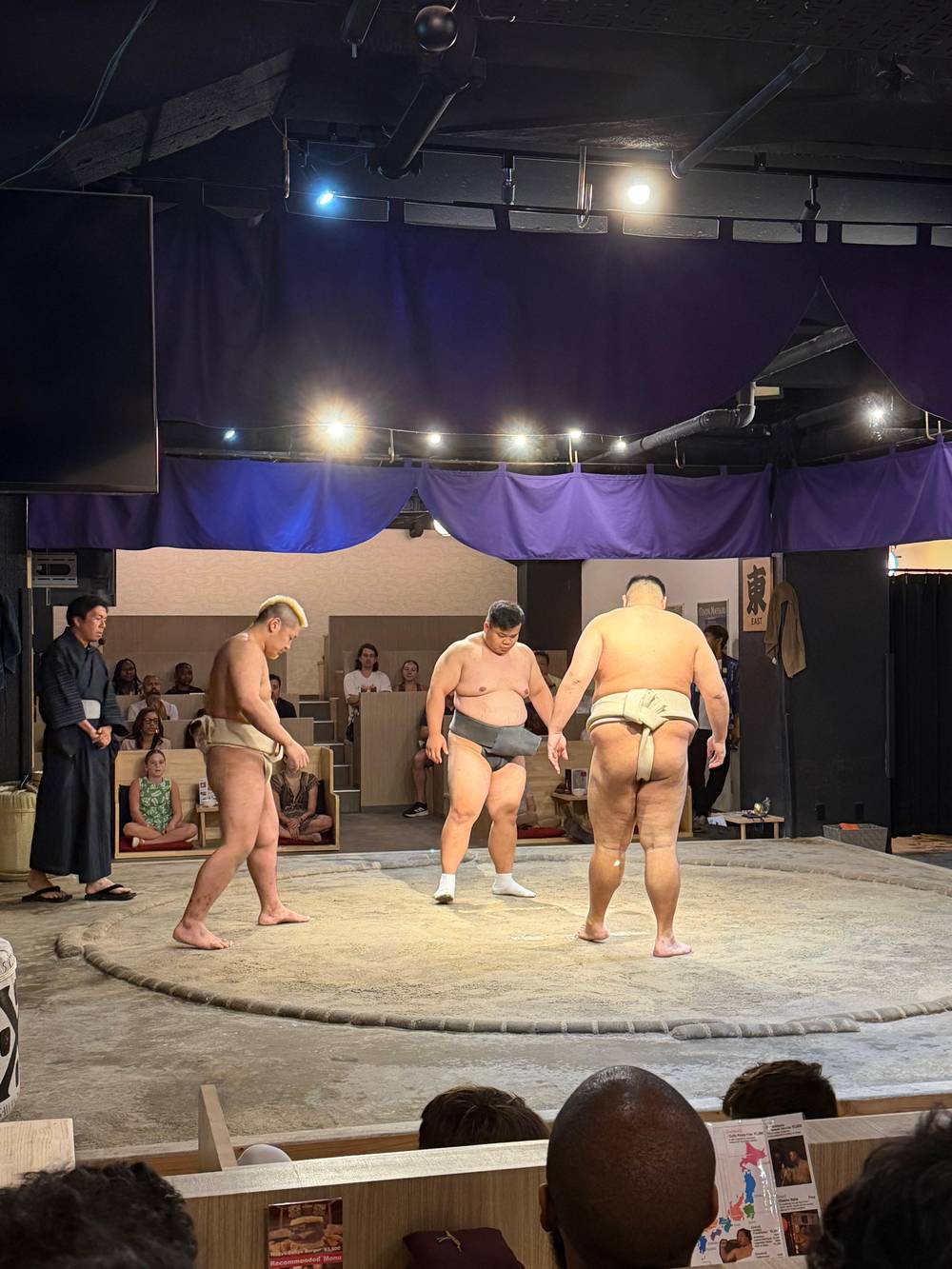
THE SUMO LIVE RESTAURANT HIRAKUZA GINZA TOKYO on YouTube · The video only starts loading on your tap.
The dining portion of the evening is designed as an integral part of the show, planned to occur between 5:00 PM and 6:00 PM.
Changing to the halal set or the vegan kaiseki costs nothing extra at the 17:00 and 20:30 shows.5 The venue describes the halal set as a Japanese-style tray meal cooked at a halal-certified facility, with a chanko nabe seasoned to halal specification and cooked in its own kitchen.36 The vegan kaiseki is 100 percent plant-based and built around a yuba hot pot and tempura udon.25
Children aged 3 to 12 get the castle box, a two-tier lunchbox shaped like a castle with favorites such as hamburger steak and fried shrimp, and the venue prices that age band separately except at VIP ringside.27,21 Infants aged 0 to 2 can enter free if they watch from a parent's lap, although a child who takes a seat needs a ticket.37 The Viator listing likewise gives children aged 3 to 12 a kids plate.
The venue says it uses no pork, so a pork-free diet needs no special order.7 Outside food and drink are not allowed in the room, so a family with a picky eater cannot slip in a snack.33 Dishes and drinks can be ordered during the show from a QR code on your seat.15
Drinks are the line item that surprises people. At the 17:00 show they are ordered and paid for separately, and at the 20:30 show one drink comes with the meal.3 You order from the QR code at your seat, so there is no need to catch a waiter's eye in a dark room.15 Anything you bring from outside is not allowed.33
A sake bar inside the venue pours sake from breweries in the Nada-gogo district of Hyogo Prefecture and opens at 13:00.38,39 You do not need a show ticket to use it, and there is a non-alcoholic menu.16,40 Under Japanese law anyone under 20 cannot taste or buy sake there, although they may walk in with their party.41 A glass before the doors open is an easy way to spend the waiting time.
To choose a seat for the food alone, the logic is short. Standard gives the broadest view of the room with the regular meal at the lowest venue price, Premium puts you in the front seats close to the ring with the same regular meal, and VIP ringside is the one tier that changes what is on the plate.23,2,34 If a sumo show and dinner in Tokyo is a once-only evening, the regular meal is already a proper kaiseki.
FAQ
Drinks cost extra at the 17:00 show, and one drink is included at the 20:30 show.3
Sources
Wondering what a sumo dinner in Ginza is really like? A real person answers here.