Help with your choice
How to watch sumo, from the salt to the final push
Live sumo show with kaiseki dinner
★ 4.9 · 257 ratings
Quick summary
To watch sumo, follow the bout from the salt to the tachiai: it is won by forcing the opponent out of the inner circle or throwing him, and it is usually over quite quickly.
What to look for
Two taps to a first bout
Where will you learn to watch?
Choose the kind of evening you want and the matching way to see a bout shows up.
Your match
A sumo show with the rules explained
from $123
The techniques and rules are explained first, then the bouts are performed.43,44
Your match
A Grand Tournament in Tokyo
Tokyo hosts the January tournament, and the others in May and September.36
Sumo bouts are quick and the rituals around them are long. This guide shows you what to look for in the ring, how a winner is decided, who the judges are and how a tournament is built, using the Japan Sumo Association's own words.
Editorial team, ginzasumoshows.com · Updated November 6, 2026 · Read in 6 min
The essentials
- RingThe dohyo is 6.7 m square, with a bout circle a little over 4.55 m across.1,2
- The winA bout is won by forcing the opponent out of the circle or throwing him.3
- StartThe tachiai is the moment the rikishi synchronize their breathing and begin.4
- LengthA bout is usually over quite quickly, in less time than the warming up.5
- TournamentA Grand Tournament lasts 15 days, six times a year.6,7
Start with the ring
Before you learn how to watch sumo, learn to read the ring. The dohyo is 6.7 m square and 60 cm high.1 Bouts are confined to an inner circle a little over 4.55 m in diameter, marked by straw bales.2 Every result you see comes down to that circle and that raised surface.
The clay platform itself is the measure of the contest. A bout is won by forcing one's opponent out of the inner circle or throwing him in the dohyo.3 That one sentence covers nearly everything: if you see someone pushed beyond the bales, or flung to the clay, the bout is over.
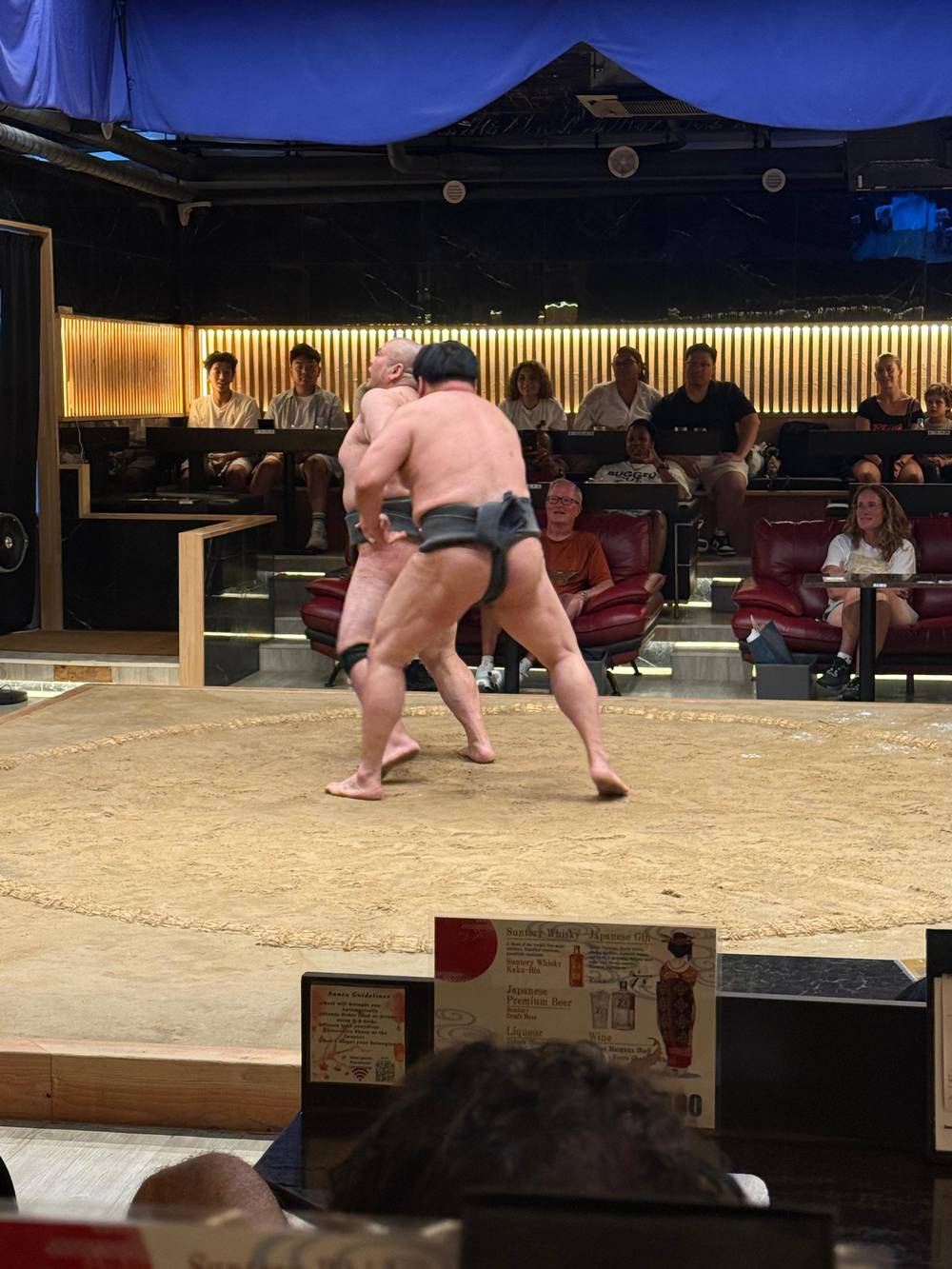
The dinner show in Ginza uses a dohyo stage, but the venue does not publish its measurements, so the figures above describe a real tournament ring.8 Still, the geometry of the contest, push out or throw down, is the same idea you will learn to see in the show.
The rules at a glance
What ends a bout, and what is not allowed
| Situation | Result | Source |
|---|---|---|
| Pushed out of the inner circle or thrown | The pushed or thrown rikishi loses3 | Japan Sumo Association |
| Any body part touches the ground, even a fingertip or topknot | That rikishi loses15 | Japan Sumo Association |
| A toe or heel over the straw bales | That rikishi loses16 | Japan Sumo Association |
| Striking with fists, hair pulling, eye gouging, choking | Prohibited18 | Japan Sumo Association |
| Open-handed slaps and shoulder chops | Allowed17 | GO TOKYO |
Rules as stated by the Japan Sumo Association and GO TOKYO.3
How a bout is won, and how it is lost
There are more ways to lose than to fall. The rikishi who touches the ground with any part of his body loses, and the Association stresses that this includes a fingertip or even the topknot.15 A rikishi also loses by putting one toe or his heel over the straw bales that mark the circle.16
What is allowed is broad. GO TOKYO notes that as long as it is not a closed fist, slaps and shoulder chops and other aggressive moves are all on the table.17 The Association lists the exceptions: striking with fists, hair pulling, eye gouging, choking and kicking in the stomach or chest are prohibited.18
Because there are no weight limits, a wrestler can be pitted against an opponent much heavier than himself.19 Technique counts as well. There are 82 winning techniques, many of them achieved by maneuvering the opponent with a grip on the mawashi.20 You do not need to memorize them; just notice whether the winner pushed, pulled or lifted.
The ritual before the clash
What looks like delay is part of the contest. Each rikishi scatters a handful of salt to purify the ring.9 GO TOKYO adds that the salt is a purification ritual meant to ward off evil spirits and ask for protection from injury.23 Watch for the arc of the hand and the clear white scatter against the clay. Rikishi in the two top divisions also receive purifying water from the winner of the previous bout, or from a competitor on their side, and rinse their mouth with it.24
Then comes the face-off. The part of the ritual in the center of the ring is called the shikiri.10 The rikishi do not begin at once; they go back to their corners for more salt, scatter it and return to face each other.11 They repeat this for the full four minutes the rules allow, though juryo rikishi have only three minutes.12,21
Finally the bout begins at the tachiai, the moment when the rikishi synchronize their breathing, rise and begin the bout.4 After all that waiting, the contest itself is usually over quite quickly, in less time than it took the warming up.5 Watch the first second closely.
Who decides the result
On the clay, the referee, called the gyoji, gives the signal to start with his fan.26 He enters the dohyo with the competing rikishi and calls out their names in a specially trained voice.27 Referees are graded, and only a tate-gyoji, the top-ranking kind, can officiate a bout involving a yokozuna.28
Around the ring sit five shimpan, the judges, for every match.13 If there is doubt about the referee's decision, they may overrule it or order a rematch.14 After a close bout you may see the judges confer while the crowd waits.
GO TOKYO points out the absence of technology: no video replay and no electronic assistance, with results judged by professional referees.29 The decision is human, visible and final, which is part of the appeal of watching in person. In a show format you may see a lighter version of the same drama.
One bout in order
From salt to decision
First
Salt is scattered
Each rikishi scatters a handful of salt to purify the ring.9
Then
Shikiri, the face-off
They return to corners for more salt and face each other again.10,11
Up to 4 min
The wait
The rules allow four minutes; juryo have three.12
The clash
Tachiai
The rikishi synchronize their breathing, rise and begin.4
Seconds later
Usually over
The bout is quite short compared with the warming up.5
Then
The judges
Five shimpan can overrule the referee or order a rematch.13,14
How a sumo tournament works
The calendar is the simplest answer to how a sumo tournament works. There are six Grand Tournaments a year, of which three are held in Tokyo and one each in Osaka, Nagoya and Fukuoka.7 A tournament lasts 15 days.6 In the two top divisions, each rikishi competes once every day, against a different opponent.30
The winner is the rikishi with the best record, and he is awarded the Emperor's Cup on the final day.31 There are three additional prizes, but to be eligible for them a rikishi must also have won at least eight of his fifteen matches.32 In the lower divisions rikishi compete on only seven days.33
The day itself builds as it goes. Matches start in the morning with the lowest-ranking rikishi and rise through the ranks to the yokozuna bouts at the end of the day.22 Just before the makuuchi matches, the dohyoiri ceremony, the entering of the ring, takes place.34 The concluding rite of the day is the yumitorishiki.35
Video
How a sumo tournament really works
SumoSpirit on YouTube · The video only starts loading on your tap.
The matches start in the morning with those of the lowest-ranking rikishi, followed by those of progressively higher and higher rank, building up to a climax towards the end of the day with the bouts featuring the yokozuna
Checklist
Before your first bout
How many sumo tournaments in a year, and where
The count is six, and the places are fixed by month. The Tokyo tournaments are at Kokugikan in January, May and September, the Osaka one is at EDION Arena Osaka in March, July is at IG Arena, and November is at the Fukuoka Kokusai Center.36,37,38,39,40,41 Dates change each year, so check the Association's schedule.
Demand is high, and a real tournament day is a full-day affair that starts in the morning with lower-ranked contenders and finishes in early evening with the highest-ranked.42 GO TOKYO reports that in 2024 tickets for all 90 match days sold out for the first time in 28 years.25 Book early for a real tournament; a dinner show is the calmer way to meet the sport.
The Ginza show is not an official match, as the venue says.8 It is an introduction, with the techniques and rules explained and bouts performed.43,44 If you go to the show first, you will recognize the tachiai, the salt and the winning conditions when you later sit in a real arena.
A first-timer's way of watching
Pick one wrestler per bout and follow only him. Watch his hands at the tachiai, then his feet at the edge of the circle. At the end, ask the three questions the rules actually ask: did he leave the circle, did anything but his feet touch the clay, did he step on a bale?3,15,16
Notice who is not in the ring. The order of the day means the early bouts feature the lowest-ranking rikishi, so the crowd and the quality build as the afternoon goes on.22 If you only have an hour, aim for the end of the day. At the Kokugikan, box seats are generally for a group of four with small cushions, and a table seat with chairs is more comfortable.45
Last, learn the sound of the room. There are no TVs inside the arena at a tournament, and results come from the people at the ring.46,29 The dinner show gives you the same attention-to-the-moment in a smaller room. Take the lessons with you and the next tournament page will read like a story.
FAQ
Straight answers to common questions.
How is a sumo bout won?
A bout is won by forcing the opponent out of the inner circle or throwing him in the dohyo.3
What can make a wrestler lose?
How big is the ring?
How long does a bout last?
The bout is usually over quite quickly, in less time than the warming up took.5
Who judges a close bout?
Is there video replay?
GO TOKYO notes there is no video replay and no electronic assistance.29
Sources
- Japan Sumo Association · SUMO (Nihon Sumo-Kyokai introduction booklet) ↩
- Japan Sumo Association · SUMO (Nihon Sumo-Kyokai introduction booklet) ↩
- Japan Sumo Association · SUMO (Nihon Sumo-Kyokai introduction booklet) ↩
- Japan Sumo Association · SUMO (Nihon Sumo-Kyokai introduction booklet) ↩
- Japan Sumo Association · SUMO (Nihon Sumo-Kyokai introduction booklet) ↩
- Japan Sumo Association · SUMO (Nihon Sumo-Kyokai introduction booklet) ↩
- Japan Sumo Association · SUMO (Nihon Sumo-Kyokai introduction booklet) ↩
- THE SUMO LIVE RESTAURANT HIRAKUZA GINZA TOKYO (official site) · FAQ ↩
- Japan Sumo Association · SUMO (Nihon Sumo-Kyokai introduction booklet) ↩
- Japan Sumo Association · SUMO (Nihon Sumo-Kyokai introduction booklet) ↩
- Japan Sumo Association · SUMO (Nihon Sumo-Kyokai introduction booklet) ↩
- Japan Sumo Association · SUMO (Nihon Sumo-Kyokai introduction booklet) ↩
- Japan Sumo Association · SUMO (Nihon Sumo-Kyokai introduction booklet) ↩
- Japan Sumo Association · SUMO (Nihon Sumo-Kyokai introduction booklet) ↩
- Japan Sumo Association · SUMO (Nihon Sumo-Kyokai introduction booklet) ↩
- Japan Sumo Association · SUMO (Nihon Sumo-Kyokai introduction booklet) ↩
- Tokyo Convention & Visitors Bureau (GO TOKYO) · Sumo for the Win ↩
- Japan Sumo Association · SUMO (Nihon Sumo-Kyokai introduction booklet) ↩
- Japan Sumo Association · SUMO (Nihon Sumo-Kyokai introduction booklet) ↩
- Japan Sumo Association · SUMO (Nihon Sumo-Kyokai introduction booklet) ↩
- Japan Sumo Association · SUMO (Nihon Sumo-Kyokai introduction booklet) ↩
- Japan Sumo Association · SUMO (Nihon Sumo-Kyokai introduction booklet) ↩
- Tokyo Convention & Visitors Bureau (GO TOKYO) · Sumo for the Win ↩
- Japan Sumo Association · SUMO (Nihon Sumo-Kyokai introduction booklet) ↩
- Tokyo Convention & Visitors Bureau (GO TOKYO) · Sumo for the Win ↩
- Japan Sumo Association · SUMO (Nihon Sumo-Kyokai introduction booklet) ↩
- Japan Sumo Association · SUMO (Nihon Sumo-Kyokai introduction booklet) ↩
- Japan Sumo Association · SUMO (Nihon Sumo-Kyokai introduction booklet) ↩
- Tokyo Convention & Visitors Bureau (GO TOKYO) · Sumo for the Win ↩
- Japan Sumo Association · SUMO (Nihon Sumo-Kyokai introduction booklet) ↩
- Japan Sumo Association · SUMO (Nihon Sumo-Kyokai introduction booklet) ↩
- Japan Sumo Association · SUMO (Nihon Sumo-Kyokai introduction booklet) ↩
- Japan Sumo Association · SUMO (Nihon Sumo-Kyokai introduction booklet) ↩
- Japan Sumo Association · SUMO (Nihon Sumo-Kyokai introduction booklet) ↩
- Japan Sumo Association · SUMO (Nihon Sumo-Kyokai introduction booklet) ↩
- Japan Sumo Association · Grand Tournament Schedule ↩
- Japan Sumo Association · Grand Tournament Schedule ↩
- Japan Sumo Association · Grand Tournament Schedule ↩
- Japan Sumo Association · Grand Tournament Schedule ↩
- Japan Sumo Association · Grand Tournament Schedule ↩
- Japan Sumo Association · Grand Tournament Schedule ↩
- Tokyo Convention & Visitors Bureau (GO TOKYO) · Sumo for the Win ↩
- THE SUMO LIVE RESTAURANT HIRAKUZA GINZA TOKYO (official site) · FAQ ↩
- THE SUMO LIVE RESTAURANT HIRAKUZA GINZA TOKYO (official site) · FAQ ↩
- Tokyo Convention & Visitors Bureau (GO TOKYO) · Sumo for the Win ↩
- Tokyo Convention & Visitors Bureau (GO TOKYO) · Sumo for the Win ↩
Also worth reading