Help with your choice
Current sumo yokozuna, ranks and a wrestler's daily life
Quick summary
The current sumo yokozuna are named at the head of the banzuke, the ranking list revised after every Grand Tournament, and only 72 rikishi have ever held the rank.
Rank and pay
Two taps to your next step
How close do you want to get to a rikishi?
Say what you would like to see and a matching way into the sport appears.
Your match
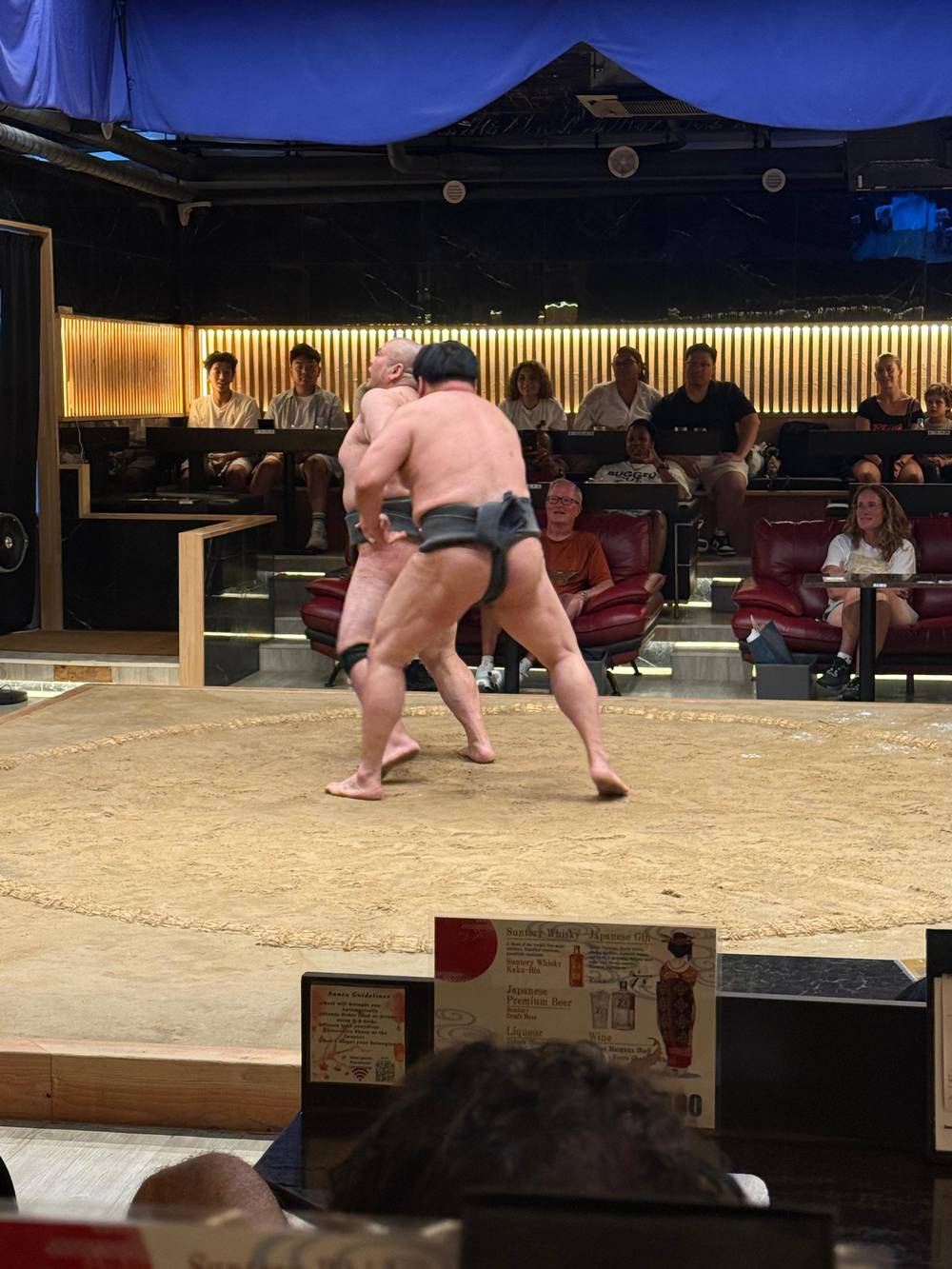
A sumo dinner show in Ginza
from $123
The program lists four performers, 176 to 188 cm tall.53
Your match
A Grand Tournament at Kokugikan
Tokyo's next one runs January 10 to 24, 2027.14 Advance tickets go on sale on December 5, 2026.40
Your match
A morning at a stable
One Nihonbashi stable trains from 6:30 a.m. to 10 a.m. and has opened its windows to visitors.5,32
Your match
The evening show instead
from $123
It brings sumo to a table with dinner, and it is not an official match.52
A dinner show puts four wrestlers in front of you. This guide explains where they sit in the ranked world, how the ranking list works, what the Association says about pay and who trains in a Tokyo stable before dawn.
Editorial team, ginzasumoshows.com · Updated November 6, 2026 · Read in 6 min
The essentials
- Top rankThe yokozuna occupy the top rank, and the Association's introduction booklet counts only 72 rikishi so honored, a figure that has since grown.1,2
- Size of the worldAbout 700 rikishi are in professional sumo, from trainee to yokozuna.3
- PayWrestlers of juryo and above are paid a salary plus allowances.4
- Early startAt one Tokyo stable, training runs from 6:30 a.m. until 10 a.m.5
- From abroadWrestlers born in Mongolia keep reaching the top division.6
Who the current sumo yokozuna are, and how to check
If you want the current sumo yokozuna by name, the right place to look is the banzuke, the ranking list the Japan Sumo Association revises after each Grand Tournament.7 Heading the banzuke in large bold characters are the names of the upper-division rikishi, and at the very top sit the yokozuna.8,1 This page does not print names, because a list of names goes stale at the next tournament.
What does stay true is the structure. The yokozuna occupy the top rank in professional sumo.1 Ozeki was once the highest rank but is now second to yokozuna, and sekiwake is the next highest rank after ozeki.9,10 The Association's introduction booklet counts only 72 rikishi honored with the rank of yokozuna over the long history of the professional sport; a few more have been promoted since it was printed, so check the banzuke for the latest count.2
The rank also comes with duties and a hard limit. A yokozuna can never be demoted, but he is expected to retire if his records stay poor.11 Before promotion a rikishi must have won two consecutive tournaments or achieved equivalent records at ozeki.12 Those are the conditions for the rank. Referees are graded too, and only a tate-gyoji, a top-ranking referee, can officiate a bout involving a yokozuna.13
Pay and bouts by rank
What the divisions fight for
| Group | Days in the ring | How they are paid |
|---|---|---|
| Juryo and above | Competes every day of the 1521,22 | Salary plus allowances4 |
| Makuuchi, the top division | Up to 42 rikishi20 | Salary, with a special allowance for the upper ranks4 |
| Lower divisions | Only seven days23 | Allowance per tournament and an encouragement payment31 |
Divisions, bout days and pay structure as the Japan Sumo Association states them.4
The ladder below the top
There are up to 42 makuuchi rikishi, the top division.20 In a Grand Tournament, each rikishi in the two top divisions competes once every day, against a different opponent.21 The tournament lasts 15 days, so a top-division wrestler is in the ring on every one of those days.22
Wrestlers in the lower divisions compete on only seven days.23 That gap changes the whole shape of a career, because a young wrestler in the lower ranks fights less often and trains in stable life for the rest of the time. After each tournament the banzuke is revised, with rikishi promoted or demoted by their performance.7
Age and comebacks sit on the same ladder. On the latest banzuke, one wrestler returned to the top division at 41 years and 11 months, the oldest to do so since World War II.24 Another became the first rikishi from Okinawa Prefecture to reach komusubi.25 Careers move at very different speeds: one juryo debutant took 6 tournaments from his professional debut, tying the fastest promotion overall, while the new komusubi took 63 tournaments, the slowest among rikishi who succeeded in amateur sumo as students.26,27 The list of firsts is long, and the Association publishes it in its banzuke topics.
Hair, belts and ceremonial costume
A rikishi's rank shows in his hair. Juryo and makuuchi wear the elaborate oichomage, named after the ginkgo leaf, while the lower ranks use the chonmage, a plainer style tied with paper strings.34,35 The styles come from the Edo period and also serve as head protection in falls.36
The belt, the mawashi, is made of heavy silk about 9 m long and 80 cm wide, folded and wrapped around the waist four to seven times.28 For ceremonies the top divisions wear silk aprons that cost upwards of approximately 1 million yen.37 At the ring-entering ceremony the yokozuna adds a braided hemp rope that usually weighs 11 to 15 kg.38
Names have their own rules. Sumo names often end in -yama for mountain, -kawa or -gawa for river, or -umi for sea.39 When the performers at a dinner show give their names, listen for those endings; the pattern tells you something about the culture, even when the stage name is only for the show.
Life in a stable before dawn
Wrestlers eat, sleep and train in stables, and the Ryogoku area in Sumida City is famously known as the home of sumo in Tokyo.42 One stable in Nihonbashi, in Chuo City, has opened its windows so that visitors can watch training.32 It was founded in 2002 and is home to 14 wrestlers.43
The day starts early. The wrestlers there begin training at 6:30 a.m. and continue only until 10 a.m.5 One of them gives the reason in his own words: the rhythm of waking up early, practicing, eating and then sleeping helps them become bigger and stronger.33 He also says that roughly 90% of the people who come to watch are from overseas.41
Hierarchy shapes the floor. On a provincial tour, the lower divisions start and finish their intense training early to make way for the upper divisions.44 Chanko nabe, the stew associated with the stables, is a hotpot of chicken, pork, fish, sometimes beef, and vegetables.45 If you taste it at a restaurant, you are eating the food of the system described here. A wrestler there says sumo is different from other sports because nothing is used besides your own body.46
A wrestler's year
Tournaments and tours across the calendar
January
Tokyo basho
At Kokugikan, January 10 to 24, 2027.14
March
Osaka basho
At EDION Arena Osaka, March 14 to 28, 2027.15
May
Tokyo basho
At Kokugikan, May 9 to 23, 2027.16
July
Nagoya basho
At IG Arena, July 11 to 25, 2027.17
September
Tokyo basho
At Kokugikan, September 12 to 26, 2027.18
November
Fukuoka basho
At Fukuoka Kokusai Center, November 14 to 28, 2027.19
What pay in sumo looks like on paper
Searches for a sumo yokozuna salary return many numbers, and this site quotes none of them, because we print only figures an official source states. What the Japan Sumo Association's annual business report does state is the structure. Wrestlers of juryo and above receive a salary and allowances, and the highest ranks receive a special tournament allowance.4
Below juryo the system is different. Wrestlers there receive a per-tournament allowance and an encouragement payment instead of a salary.31 That is the line between a salaried wrestler and one still building a career.
There are also costs. A silk ceremonial apron for the top divisions costs upwards of approximately 1 million yen.37 An Edo-period verse called sumo an occupation of only twenty days of annual work.47 After 1778 the tournament period was extended from eight days to ten days.48 Today the Grand Tournaments run for 15 days each, six times a year.22,49
Video
What do sumo wrestlers do all day besides training
The Tatsunami Stable - Sumo Foods on YouTube · The video only starts loading on your tap.
The reason why we start practice so early is because the rhythm of waking up early, practicing, eating, and then sleeping helps us to become bigger and stronger.
Checklist
To follow sumo beyond the show
Keep up with the ranks3
Wrestlers from abroad
People often ask about non-Japanese sumo champions, and the Association's own topics pages give a precise sense of the trend without naming a list. The two wrestlers who made their top-division debut in November 2026 are the 34th and 35th Mongolian-born rikishi to do so.6 A juryo debutant in the same tournament is the 43rd Mongolian-born rikishi to make his juryo debut.50
The Association's topics pages count debuts by birthplace. For the champions themselves, check the tournament champions page of the Association, which lists each winner of each tournament. We do not rank nationalities, and the facts do not support doing so.
The ladder is open in other ways. In the same tournament, one stable has 10 sekitori, the wrestlers of juryo and above, the most for a single stable since January 1996.51 The count is a snapshot of one tournament.
Where the dinner-show performers fit
The Ginza venue states that it is not an official Grand Sumo match.52 The program lists four performers, ranging from 176 to 188 cm in height and from 105 to 140 kg in weight.53 The venue does not say what rank any of them holds, so this guide makes no claim about it.
What you can compare is the sport's grammar. The show introduces sumo training, explains the techniques and rules, then performs the bouts.54,55,56 A real tournament, by contrast, builds from the lowest-ranking rikishi in the morning to the yokozuna at the end of the day.57
That contrast is the most useful frame for the evening. Treat the show as the friendly introduction and the Grand Tournament as the full competition. If the dinner makes you curious, the Kokugikan in Ryogoku hosts the Tokyo Grand Tournaments, which run in January, May and September.49,14,16,18
FAQ
Straight answers to common questions.
How many yokozuna have there been?
The Association's introduction booklet counts 72 rikishi honored with the rank, and a few more have been promoted since, so check the banzuke for the latest count.2
Can a yokozuna be demoted?
He is expected to retire if his records stay poor, but he cannot be demoted.11
Do all wrestlers get a salary?
Why do wrestlers start training so early?
He says the rhythm of waking up early, practicing, eating and sleeping makes them bigger and stronger.33
How many wrestlers are there?
They range from the lowly trainee to the yokozuna at the top.3
What is the topknot called?
Do foreign wrestlers reach the top division?
Two wrestlers who debuted in the top division in November 2026 were the 34th and 35th Mongolian-born.6
Sources
- Japan Sumo Association · SUMO (Nihon Sumo-Kyokai introduction booklet) ↩
- Japan Sumo Association · SUMO (Nihon Sumo-Kyokai introduction booklet) ↩
- Japan Sumo Association · SUMO (Nihon Sumo-Kyokai introduction booklet) ↩
- Japan Sumo Association · Annual business report 2024 (Japanese) ↩
- Tokyo Metropolitan Government · Where to Catch Sight of Japan's Mighty Warriors ↩
- Japan Sumo Association · 2026 November Grand Sumo Tournament Banzuke Topics ↩
- Japan Sumo Association · SUMO (Nihon Sumo-Kyokai introduction booklet) ↩
- Japan Sumo Association · SUMO (Nihon Sumo-Kyokai introduction booklet) ↩
- Japan Sumo Association · SUMO (Nihon Sumo-Kyokai introduction booklet) ↩
- Japan Sumo Association · SUMO (Nihon Sumo-Kyokai introduction booklet) ↩
- Japan Sumo Association · SUMO (Nihon Sumo-Kyokai introduction booklet) ↩
- Japan Sumo Association · SUMO (Nihon Sumo-Kyokai introduction booklet) ↩
- Japan Sumo Association · SUMO (Nihon Sumo-Kyokai introduction booklet) ↩
- Japan Sumo Association · Grand Tournament Schedule ↩
- Japan Sumo Association · Grand Tournament Schedule ↩
- Japan Sumo Association · Grand Tournament Schedule ↩
- Japan Sumo Association · Grand Tournament Schedule ↩
- Japan Sumo Association · Grand Tournament Schedule ↩
- Japan Sumo Association · Grand Tournament Schedule ↩
- Japan Sumo Association · SUMO (Nihon Sumo-Kyokai introduction booklet) ↩
- Japan Sumo Association · SUMO (Nihon Sumo-Kyokai introduction booklet) ↩
- Japan Sumo Association · SUMO (Nihon Sumo-Kyokai introduction booklet) ↩
- Japan Sumo Association · SUMO (Nihon Sumo-Kyokai introduction booklet) ↩
- Japan Sumo Association · 2026 November Grand Sumo Tournament Banzuke Topics ↩
- Japan Sumo Association · 2026 November Grand Sumo Tournament Banzuke Topics ↩
- Japan Sumo Association · 2026 November Grand Sumo Tournament Banzuke Topics ↩
- Japan Sumo Association · 2026 November Grand Sumo Tournament Banzuke Topics ↩
- Japan Sumo Association · SUMO (Nihon Sumo-Kyokai introduction booklet) ↩
- Japan Sumo Association · SUMO (Nihon Sumo-Kyokai introduction booklet) ↩
- Japan Sumo Association · SUMO (Nihon Sumo-Kyokai introduction booklet) ↩
- Japan Sumo Association · Annual business report 2024 (Japanese) ↩
- Tokyo Metropolitan Government · Where to Catch Sight of Japan's Mighty Warriors ↩
- Tokyo Metropolitan Government · Where to Catch Sight of Japan's Mighty Warriors ↩
- Japan Sumo Association · SUMO (Nihon Sumo-Kyokai introduction booklet) ↩
- Japan Sumo Association · SUMO (Nihon Sumo-Kyokai introduction booklet) ↩
- Japan Sumo Association · SUMO (Nihon Sumo-Kyokai introduction booklet) ↩
- Japan Sumo Association · SUMO (Nihon Sumo-Kyokai introduction booklet) ↩
- Japan Sumo Association · SUMO (Nihon Sumo-Kyokai introduction booklet) ↩
- Japan Sumo Association · SUMO (Nihon Sumo-Kyokai introduction booklet) ↩
- Japan Sumo Association · Grand Tournament Schedule ↩
- Tokyo Metropolitan Government · Where to Catch Sight of Japan's Mighty Warriors ↩
- Tokyo Metropolitan Government · Where to Catch Sight of Japan's Mighty Warriors ↩
- Tokyo Metropolitan Government · Where to Catch Sight of Japan's Mighty Warriors ↩
- Japan Sumo Association · A day at Jungyo (Provincial Tour) ↩
- Tokyo Convention & Visitors Bureau (GO TOKYO) · Sumo for the Win ↩
- Tokyo Metropolitan Government · Where to Catch Sight of Japan's Mighty Warriors ↩
- Tokyo Metropolitan Library · Grand Sumo Special: Sumo is an occupation that requires only twenty days of annual work ↩
- Tokyo Metropolitan Library · Grand Sumo Special: Sumo is an occupation that requires only twenty days of annual work ↩
- Japan Sumo Association · SUMO (Nihon Sumo-Kyokai introduction booklet) ↩
- Japan Sumo Association · 2026 November Grand Sumo Tournament Banzuke Topics ↩
- Japan Sumo Association · 2026 November Grand Sumo Tournament Banzuke Topics ↩
- THE SUMO LIVE RESTAURANT HIRAKUZA GINZA TOKYO (official site) · FAQ ↩
- THE SUMO LIVE RESTAURANT HIRAKUZA GINZA TOKYO (official site) · THE SUMO LIVE RESTAURANT HIRAKUZA GINZA TOKYO ↩
- THE SUMO LIVE RESTAURANT HIRAKUZA GINZA TOKYO (official site) · FAQ ↩
- THE SUMO LIVE RESTAURANT HIRAKUZA GINZA TOKYO (official site) · FAQ ↩
- THE SUMO LIVE RESTAURANT HIRAKUZA GINZA TOKYO (official site) · FAQ ↩
- Japan Sumo Association · SUMO (Nihon Sumo-Kyokai introduction booklet) ↩
Also worth reading